Summer Heat Protection: Why Your Building Is Now Under Scrutiny
Hot summers highlight just how much indoor temperatures affect comfort, safety, and liability. In Germany, summer heat protection is regulated by the Building Energy Act (GEG) and the DIN 4108-2 standard, particularly for new construction and major renovations.
This issue is particularly critical in places where people rely on reliable indoor conditions, such as offices, shopping centers, hospitals, schools, and universities.
%201.webp)
What You Need to Know Right Now:
As a building owner and operator, you are responsible for ensuring appropriate indoor conditions for tenants. Summer heat protection is therefore not only a matter of building physics but also a business issue.


Climate Change as a Driver
More frequent and intense heat waves are increasing the risk of overheating even in buildings that previously showed no signs of this problem. Thermal insulation is becoming increasingly important for existing buildings.

Legal Risks
DIN 4108-2 specifies how often a room temperature of 24 to 26 °C may be exceeded over the course of a year. If this limit is exceeded, there is a risk of violating occupational safety regulations, for example in offices or hospitals.

Claims for Rent Reduction
If tenants can prove that the agreed-upon living conditions are not being met on a long-term basis, they can reduce their rent. This, of course, has direct financial consequences for you as the landlord.

Lack of Contractual Certainty
Without precise knowledge of how many hours per room the permissible temperature is exceeded, it is not possible to draft reliable contracts that will hold up in the event of a dispute.

A complex interplay of many factors
The U-value and g-value of the windows, orientation, type and control of shading, ventilation design, cooling technology, as well as user behavior and internal heat loads all interact simultaneously and vary from room to room. Generalizations about an entire building are therefore insufficient.

Unclear Basis for Decision-Making
Without a room-specific simulation, it remains unclear whether planned or existing measures—such as shading, ventilation, or active cooling—are actually sufficient to meet the requirements of DIN 4108-2 over the course of a full year.
Summer Heat Protection with the Digital Twin
The LEAFTECH solution:
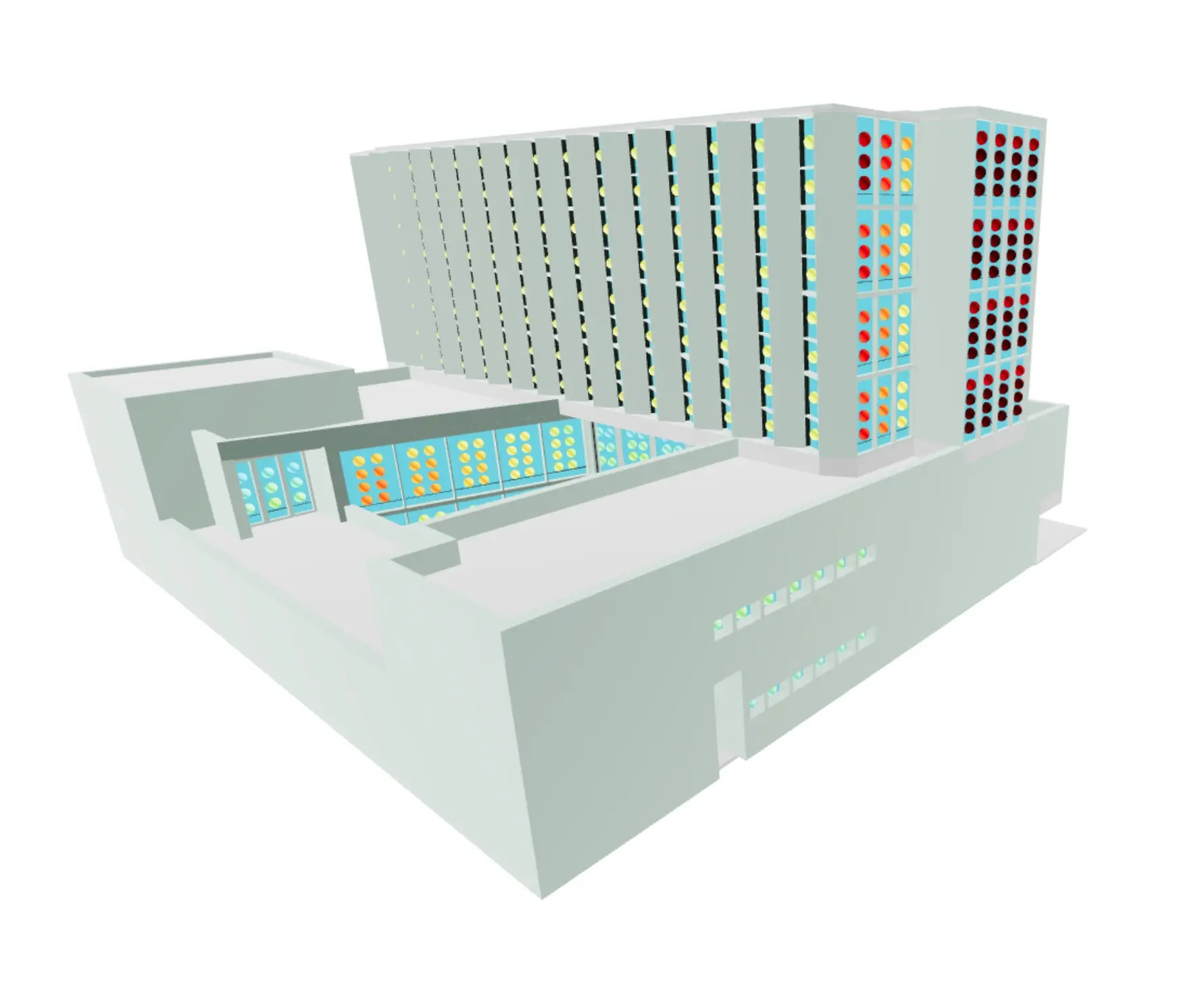
Using your building’s digital twin and a detailed thermal simulation. We digitally model the building envelope, windows, shading, ventilation, and cooling systems, and simulate the thermal behavior on a room-by-room basis over the course of a full year. The result is data-based verification of summer thermal protection in accordance with DIN 4108-2.
Unlike analyses focused on individual rooms, the digital twin models the entire building, including the interactions between systems, rooms, weather, and usage. This also reveals potential conflicts, such as when central systems—like concrete core activation—cannot control each room independently.
This answers the key questions:

Does my building comply with DIN 4108-2?
We determine, on a room-by-room basis, how often the permissible temperature limit (24–26 °C) is exceeded.
Which rooms are at risk of overheating, and why?
The digital twin models the interaction between the building envelope, window specifications, orientation, shading, ventilation, and cooling.
Is my shading sufficient?
We evaluate the location, materials, and control systems of your sun protection systems, whether automated or manual.
Which technical solution makes the most economic sense?
From nighttime ventilation to mechanical ventilation to concrete core activation: We’ll show you which combination achieves the target values.
What does this mean for my operating costs?
We quantify the expected energy demand as a basis for investment decisions.
How can I protect myself legally as a property owner?
Reliable data on building performance forms the basis for secure lease agreements and operator obligations.
%20(1).png)